
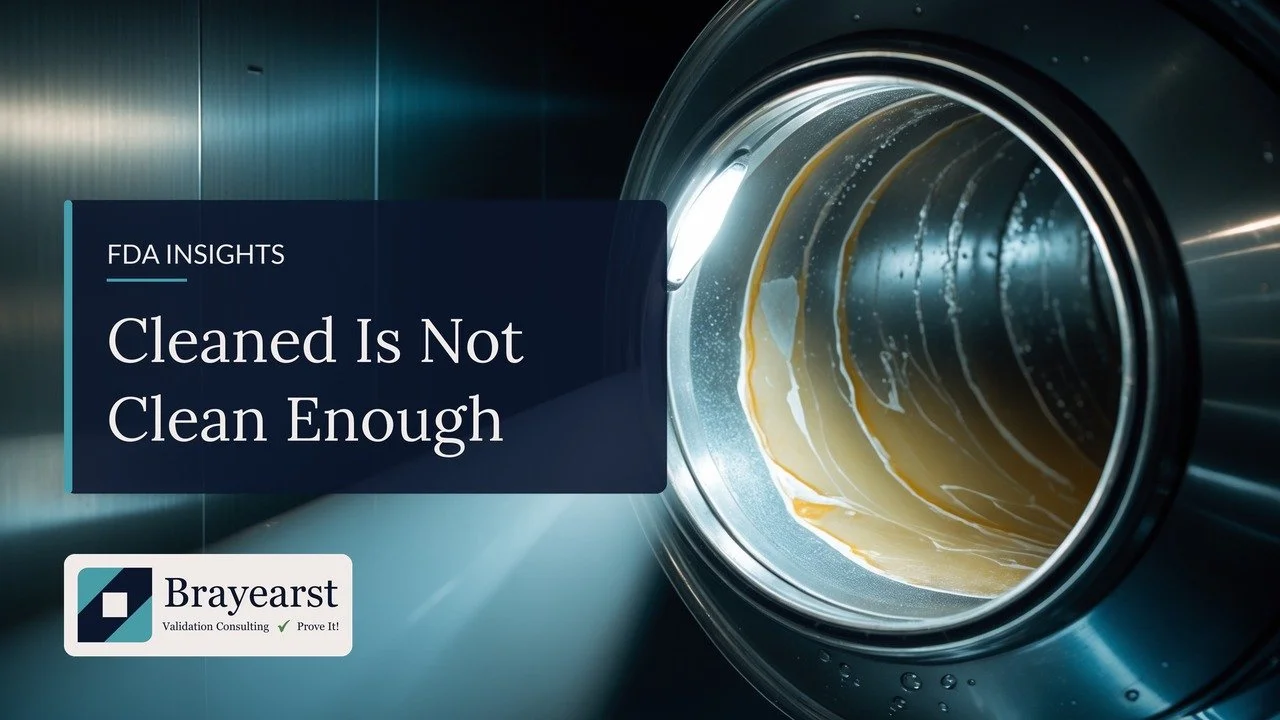
Our latest video examines an FDA warning letter finding issued to a finished drug manufacturer running its products on shared equipment. The finding is a useful study in the difference between equipment that has been cleaned and equipment that has been shown to be clean. This post walks through what the letter documents, what each part of the finding signals, and how a cleaning validation strategy would change the outcome. Identifying details have been generalized; the principle, not the manufacturer, is the point.
What the finding documents
Under 21 CFR 211.67(a), equipment and utensils must be cleaned, maintained, and, as appropriate, sanitized or sterilized at appropriate intervals to prevent malfunctions or contamination that would alter the safety, identity, strength, quality, or purity of the drug product. Shared, non-dedicated equipment is common and permitted under that requirement, provided the cleaning between products prevents one product from contaminating the next.
In this finding, the FDA cited a manufacturer whose non-dedicated equipment, shared across products, retained residues of different products in its exhaust ducts. As the letter reports it, testing of reserve samples confirmed carryover of active ingredients from prior products into later batches in several instances, and roughly one in ten of the tested batches showed unidentified chromatographic peaks consistent with residue from earlier products. The FDA found the manufacturer's response inadequate, describing its explanations for the contamination as equivocal and noting that it presented no clear analysis of the root cause.
Residue where product does not travel
The residues the letter describes were found in exhaust ducts on equipment that had already been cleaned. An exhaust is usually a waste pathway, not the route product takes to sale, so residue found there does not necessarily explain how contamination reached later batches. Its significance lies elsewhere: residue that survives cleaning anywhere in the equipment is evidence that the cleaning is not removing residue as intended. If residue remained in the ducts, the surfaces that contact product deserve the same scrutiny.
When carryover recurs
The batches themselves carry the rest of the finding. Carryover confirmed in several instances, together with unidentified peaks in roughly one in ten tested batches, describes a pattern rather than an isolated event. In our view, repeated carryover signals a gap built into the cleaning process, not a single lapse in its execution. Every changeover becomes another opportunity to pass contamination to the next product, and corrective actions aimed at an individual cleaning or an individual operator will not close a gap that lives in the process itself. Effective, validated cleaning leaves no residue to carry.
Why the explanation stayed ambiguous
The FDA's criticism of the response is worth reading closely. The letter does not fault the manufacturer for investigating; it faults the result, which left the cause of the contamination unexplained. We would trace that gap to well before the investigation began.
An investigation into contamination on shared equipment needs a starting point: which surfaces are hardest to clean, which cleaning steps carry the most risk, and which product residues are most difficult to remove. When that knowledge already exists in documented form, the investigation knows where to look first. When it does not, the investigation starts from square one, and the explanation is likely to remain ambiguous, which is the outcome the FDA described.
What a cleaning validation strategy provides
A cleaning validation strategy begins with a risk assessment of the equipment and the cleaning steps to find the highest-risk characteristics. Equipment design matters here: hard-to-clean surfaces such as gaskets, valve seats, crevices, dead legs, and other areas that are difficult to reach or observe are where residue is most likely to remain. So do the products themselves, since characteristics such as solubility and potency make some residues harder to remove or less tolerable than others. That assessment identifies the worst case the validation needs to challenge.
The validation studies then show that the cleaning removes residue to established acceptance limits at the locations the assessment identified, sampled with analytical methods sensitive enough to detect residue at those limits. Sampling only the surfaces that are easiest to reach can produce passing results while leaving the highest-risk locations unexamined.
The risk assessment does more than shape the validation. It gives any later investigation its baseline. A validated cleaning process changes each part of the story this finding tells: its risk assessment identifies the surfaces that need the most attention, its studies show that the cleaning removes residue from them, and when something does go wrong, it gives the investigation a place to start. In our view, robust cleaning validation would have exposed the gap in this finding before manufacturing began.
Cleaning assurance is a cross-functional responsibility
Cleaning validation is often treated as the validation team's work, but the assurance it provides depends on more than one function. Operations personnel perform the cleaning steps at every changeover, and the consistency of that work determines whether a validated process stays validated in practice. Projects decide when new products are introduced to shared equipment, which changes what the cleaning must remove. Quality investigates contamination and decides batch disposition, and depends on the cleaning risk baseline to reach a root cause. Regulatory responds when the FDA asks how contamination occurred, and a credible response depends on evidence the organization already holds. Validation designs the studies that tie these roles together. When each of these functions understands what cleaning validation demonstrates, gaps like the one in this finding are far more likely to surface before an inspection does.
Your experiences with shared equipment cleaning
At Brayearst Validation Consulting, we train organizations to build that understanding across every role. We would value hearing your experiences and priorities with shared equipment cleaning. If you would like an independent view of how your current cleaning validation program would hold up to a finding like this one, our validation spot check is a good place to start. You can reach us at www.brayearst.com.
© 2026 Brayearst LLC. All rights reserved.
